Why Does the Federal System Punish People Who Do Not Prepare?
About 45% of people released from federal prison are rearrested or return to custody within three years (Government Accountability Office, 2026). That statistic is not inevitable. A significant factor in whether someone successfully completes their sentence and reentry is how well they prepared for the experience before it began.
The federal criminal justice system is a bureaucracy. Like all bureaucracies, it rewards people who understand its rules and punishes those who do not. From the very first interview with a probation officer to the day you walk into a halfway house, every stage presents decisions that shape your outcome.
Most defendants face these decisions completely unprepared. Their attorneys handle the legal mechanics — plea agreements, guideline calculations, courtroom arguments. But the practical realities of navigating the Bureau of Prisons? The human elements of allocution and character letters? The logistical chaos of preparing a family for years of separation? That falls on you. And if you do not know what you are doing, you will make mistakes that cost months or years of your freedom.
That is where a federal prison consultant changes the equation entirely.
What Does a Federal Prison Consultant Actually Do?
A federal prison consultant is not an attorney and does not provide legal representation. Instead, they provide strategic guidance on the practical, personal, and logistical dimensions of the federal system that most law firms do not cover. At Federal Case Consulting, our services span every phase of the process.
Pre-Sentence Report (PSR) Preparation
Your Pre-Sentence Report is the single most important document in your federal case. It follows you from the courtroom to the prison to the halfway house and beyond. Every stakeholder — the judge, prosecutors, BOP case managers, halfway house staff, and supervised release officers — reads your PSR before making decisions about your life.
We prepare you for the PSR interview with personal narrative development, mock interviews, and a thorough review of the draft report to identify errors that could harm your BOP designation, program eligibility, or release timeline. Your attorney views the PSR through a legal lens. We view it through a holistic one — understanding how every line in that document will be interpreted by people down the line.
Sentencing Hearing Strategy
In a landmark survey by Senior U.S. District Judge Mark W. Bennett, more than 85% of federal judges said that allocution — the defendant’s personal statement to the judge — positively influenced their sentencing decisions. Yet most defendants either skip it entirely or deliver an unprepared, ineffective version.
We help you craft an authentic allocution, manage a strategic character letter campaign, and coordinate courtroom presence so that sentencing day is a planned, purposeful presentation — not a panicked performance. The difference between a well-prepared and poorly prepared sentencing hearing can be measured in months or years.
Prison Preparation
The period between sentencing and self-surrender is not a waiting room. It is a preparation window. We provide every client with our proprietary “Going to Prison” guidebook and a one-on-one transition consultation that covers intake procedures, self-surrender logistics, commissary strategy, daily routine planning, and physical and mental resilience programs.
Our clients walk into their designated facility knowing exactly what to expect — from the strip search at R&D to their first count to their first meal. That knowledge eliminates the fear of the unknown, which is the single greatest source of anxiety for people facing incarceration.
Post-Conviction Advocacy
A February 2026 GAO report found that the BOP failed to properly apply First Step Act earned time credits for 21,190 of 29,934 individuals reviewed (GAO, 2026). That means over 70% of eligible inmates were not receiving the full benefit of credits they had earned. Without someone monitoring and advocating on your behalf, the system will not correct itself.
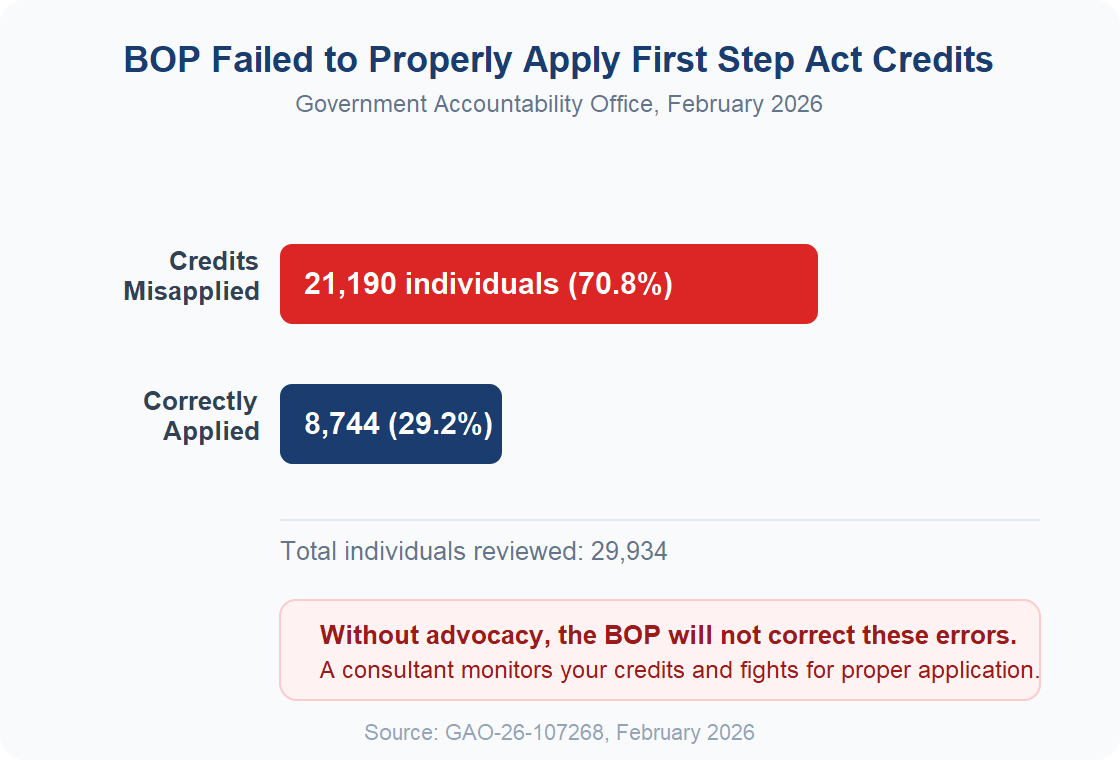
We fight for proper BOP facility designation, identify and enroll you in sentence reduction programs like RDAP (up to 12 months off your sentence) and First Step Act programming, navigate the administrative remedy process when problems arise, and strategically plan your halfway house and home confinement placement to maximize your time in the community.
The Peace of Mind Factor: Why Preparation Changes Everything
Approximately 37% of people in state and federal prisons have a diagnosed history of mental illness (NAMI). The federal court process itself — the investigation, indictment, plea negotiations, and sentencing — inflicts enormous psychological damage even on people with no prior mental health history.
Fear feeds on uncertainty. When you do not know what is going to happen next, every possibility feels like the worst possibility. Will I be safe? Where will I sleep? Can my family survive financially? What happens on the first day? What do I say to the judge? What if I make a mistake during intake?
These questions consume people facing federal time. They disrupt sleep, destroy focus, damage relationships, and create a downward spiral of anxiety that makes everything worse — including your ability to present yourself effectively at sentencing.
A federal prison consultant replaces that uncertainty with answers. Not vague reassurances. Not “it will be fine.” Specific, detailed, experience-based answers to every question that is keeping you up at night. And the psychological impact of that shift — from helplessness to preparedness — is transformative.
What Our Clients Tell Us
Every client we work with says some version of the same thing: “I wish I had found you sooner.” Not because we performed miracles. Because we gave them what no one else could — a plan. A clear understanding of what was coming and how to handle it. The ability to stop imagining the worst and start preparing for the reality.
That peace of mind extends to families too. U.S. families lose an estimated $350 billion per year due to the incarceration of a loved one, spending an average of $4,200 annually per incarcerated relative on communication, travel, commissary, and child care (Stateline/FWD.us, 2025). The financial and emotional toll on families is staggering. When we prepare both the client and their family for what is ahead, the entire support system is stronger.
How Preparation Directly Impacts Your Sentence Length
According to the U.S. Sentencing Commission, approximately 42% of federal sentences in fiscal year 2024 fell below the guideline range. That means nearly half of all federal defendants received a sentence shorter than what the guidelines recommended. The question is: are you going to be in that half, or the other half?
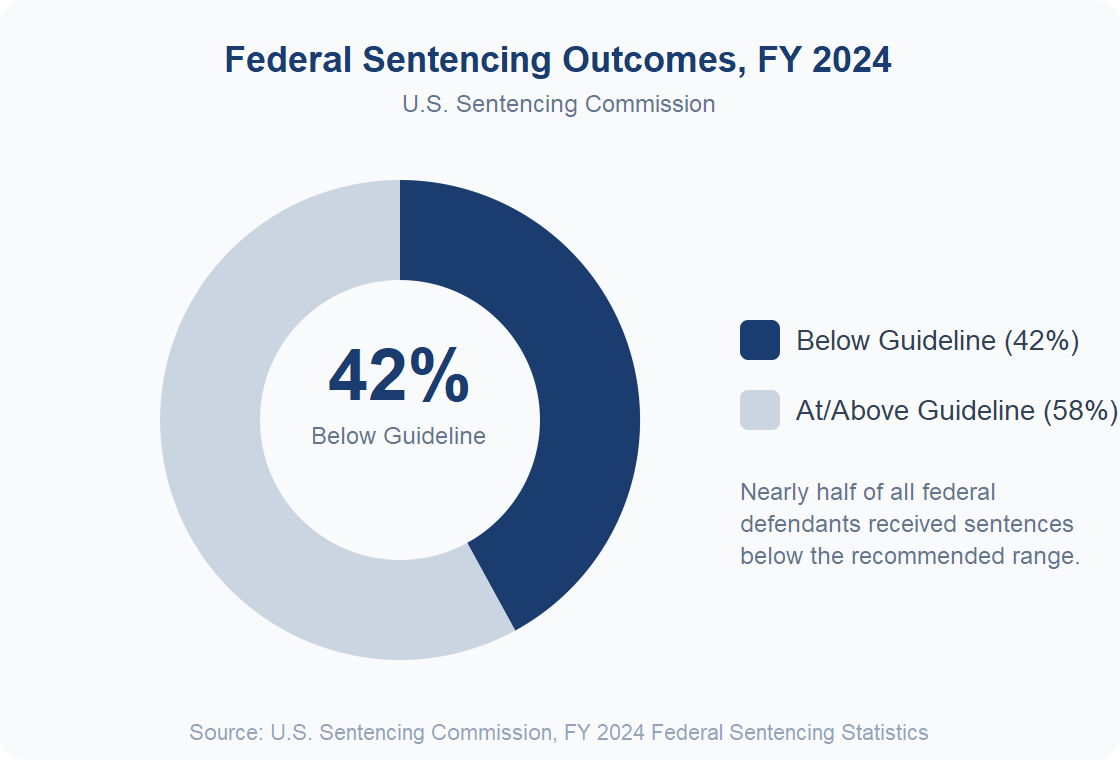
Below-guideline sentences do not happen because judges feel generous. They happen because defendants and their teams present compelling reasons — through allocution, character letters, mitigation evidence, and sentencing memoranda — for the judge to go lower. Every piece of that presentation can be strengthened by a consultant working alongside your attorney.
Beyond the initial sentence, preparation continues to pay dividends throughout incarceration:
- RDAP completion can reduce your sentence by up to 12 months — but only if you are properly screened and enrolled during intake
- First Step Act earned time credits can accelerate your transfer to a halfway house — but only if the BOP actually applies them correctly (and the GAO says they often do not)
- Good conduct time earns you 54 days off per year — but only if you avoid disciplinary incidents that come from not understanding the rules
- Halfway house placement can return you to your family and community months earlier — but only if someone is monitoring your timeline and advocating for timely transfer
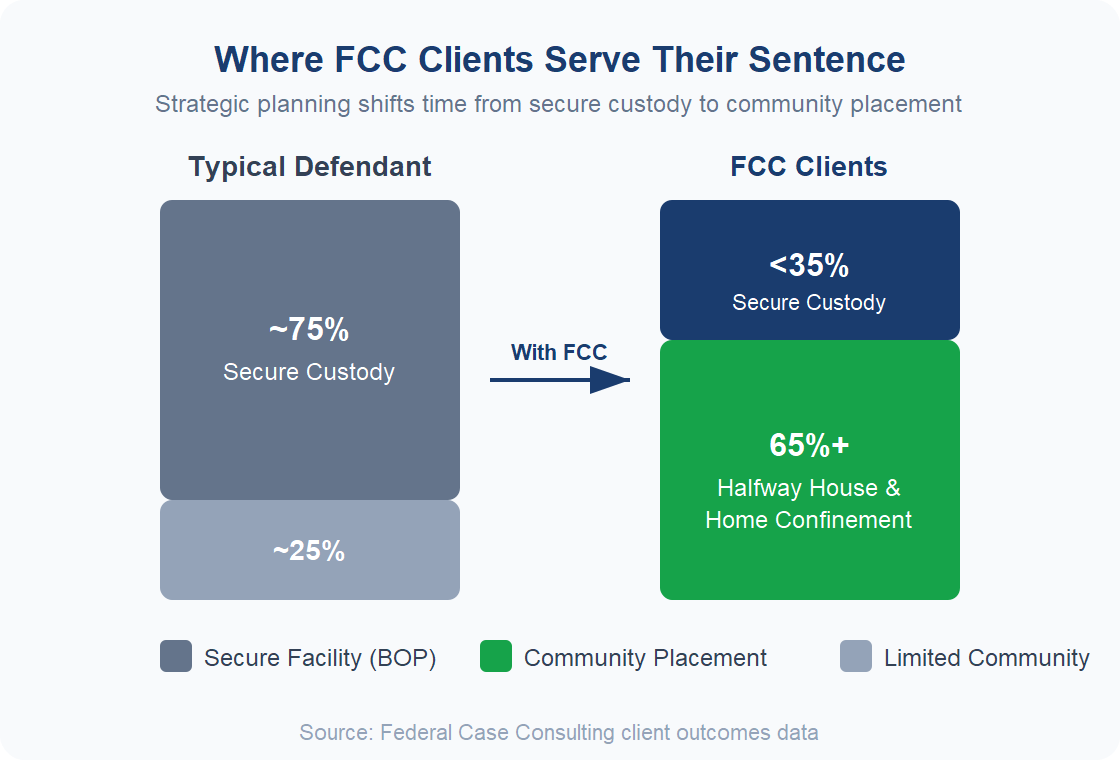
Our clients have spent less than 35% of their total sentence in Tier 1 secure custody. The remaining time was served in halfway houses and on home confinement — working, living with their families, and rebuilding their lives. That outcome is not luck. It is the result of strategic planning that begins the day they hire us.
What Happens When People Do Not Prepare?
We have seen the other side too. Clients who came to us after sentencing — sometimes after months or years inside — wishing they had prepared. The patterns are painfully consistent:
- They delivered a weak or nonexistent allocution, and the judge gave them a guideline-range sentence that might have been lower
- They minimized their substance abuse history during intake screening and disqualified themselves from RDAP — losing up to 12 months of early release
- They did not understand commissary, communication systems, or daily routines, so their first weeks were chaotic and stressful
- Their families were blindsided by visitation rules, got turned away at the door, and felt helpless for months
- Their First Step Act credits were not properly applied, and no one caught it until months after the error
- They missed the window for halfway house placement because no one was tracking their timeline
Every one of these outcomes was preventable with proper preparation. Every one of them cost real time — weeks, months, or a full year — that the person did not need to spend behind the fence.
Why Federal Case Consulting Is Different
There are other federal prison consultants. Some of them do competent work on one piece of the process. But most of them have a critical gap: they either lack the lived experience to truly understand what you are facing, or they help with one phase and leave you on your own for everything else.
We are different for three reasons that matter:
- We have been through the federal system ourselves. Our guidance is not theoretical. It is built on real, recent experience inside the BOP. We know what intake feels like, what the first night feels like, and what walking out the other side feels like. That lived experience informs every piece of advice we give.
- We cover every stage — from pre-indictment through supervised release. PSR preparation, sentencing strategy, prison preparation, family support, BOP designation advocacy, sentence reduction programs, in-prison advocacy, and reentry maximization. One team, one relationship, complete coverage.
- We are the only consultants with dedicated family support specialists. Your family is going through this too. We prepare them for visitation, communication, finances, and the emotional reality of having a loved one incarcerated. Because your stability inside depends on their stability outside.
The Real Cost of Doing Nothing
We understand that hiring a federal prison consultant is an expense during an already expensive and stressful time. But consider what doing nothing actually costs.
Every additional month of incarceration is a month away from your children, your spouse, your career, and your community. It is a month of lost income — the average family loses $1,803 per month when a loved one is incarcerated (FWD.us/Duke University, 2025). It is a month of emotional damage to your family, your mental health, and your future.
The question is not whether you can afford a federal prison consultant. The question is whether you can afford not to have one. You get one chance at your PSR interview. One chance at allocution. One chance at intake screening. One timeline for halfway house placement. There are no do-overs in the federal system.
Take Control of Your Outcome
The worst thing you can do right now is nothing. We have been where you are. Let us help you build a plan.
Call or Text: 612-605-3989
Email: info@federalcaseconsulting.com
We respond to every inquiry within 24 hours. Confidential consultations available.
Frequently Asked Questions
How early should I hire a federal prison consultant?
As early as possible — ideally at the time of indictment or guilty plea. PSR preparation requires weeks of work before the probation interview. Sentencing strategy needs six to eight weeks minimum. The earlier you engage a consultant, the more opportunities they have to influence your outcome at every stage. That said, we help clients at any point, including those already serving their sentence.
Is a federal prison consultant worth the cost?
Consider that RDAP completion alone can take up to 12 months off a federal sentence, and a well-prepared allocution can influence a judge to impose a below-guideline sentence — which happened in 42% of federal cases in FY 2024 (USSC, 2025). Every month saved is a month of income, family stability, and freedom recovered. The return on investment is measured in time — the most valuable thing you have.
Can a consultant guarantee a shorter sentence?
No honest consultant can guarantee a specific outcome. What we guarantee is thorough preparation at every stage — PSR, sentencing, prison intake, programming, and reentry. Our clients have consistently received below-guideline sentences and spent less than 35% of their time in Tier 1 secure custody. Those results come from preparation, not promises.
What is the difference between a federal prison consultant and a defense attorney?
Your attorney handles legal strategy — plea agreements, guideline objections, sentencing memoranda, and courtroom arguments. A consultant handles practical and personal preparation — PSR interview coaching, allocution development, character letter management, prison preparation, family support, BOP advocacy, and reentry planning. The two roles complement each other. Many defense attorneys actively welcome consultant involvement because it strengthens the overall presentation.
Does Federal Case Consulting help families too?
Yes. We are the only federal prison consultants with dedicated family support specialists. U.S. families spend an average of $4,200 per year per incarcerated relative (FWD.us/Duke, 2025). We prepare families for visitation, communication systems, commissary logistics, financial management, and the emotional challenges of supporting an incarcerated loved one.
Disclaimer: Federal Case Consulting does not act as your legal representation and cannot guarantee any outcomes. The information in this article is for educational purposes and should not be construed as legal advice.