What Is the Federal RDAP Program?
The Residential Drug Abuse Program is a voluntary, 500-hour, intensive treatment program operated by the Bureau of Prisons at 65 programs across 53 federal facilities (BOP). In fiscal year 2024, 12,429 federal inmates participated in RDAP (BOP First Step Act Annual Report, June 2024). It is the most intensive substance abuse treatment the BOP offers — and the only program that can directly reduce your sentence by up to one full year.
Unlike voluntary self-help groups like AA or NA that are available at most facilities, RDAP is a structured clinical program. Participants live in a dedicated housing unit with other RDAP enrollees, separated from the general population. The program uses a therapeutic community model combining individual therapy, group counseling, cognitive behavioral techniques, and relapse prevention planning.
The incentive is powerful: non-violent offenders who complete all three phases of RDAP can receive up to 12 months off their sentence, plus maximized placement in a halfway house and home confinement. For someone serving a five-year sentence, that single program can return them to their family a full year earlier.
How Does RDAP Reduce Your Federal Sentence?
Under 18 U.S.C. § 3621(e), the BOP is authorized to reduce the sentence of any non-violent offender who successfully completes RDAP by up to 12 months. The average actual reduction is approximately 8 months (Federal Prison Time). The gap between the 12-month maximum and the 8-month average exists because many inmates enter the program later than optimal, leaving less reducible time on their sentence.
This is where early preparation matters enormously. If you enter RDAP with enough time remaining on your sentence, you can earn the full 12-month reduction. If you wait too long or miss the enrollment window, you leave months of freedom on the table.
The sentence reduction is not the only benefit. RDAP completers also receive priority placement in halfway houses and home confinement during the transitional phase. Combined with First Step Act earned time credits and good conduct time, RDAP can dramatically shift the ratio of time spent in a secure facility versus time spent in the community.
The Three Phases of RDAP
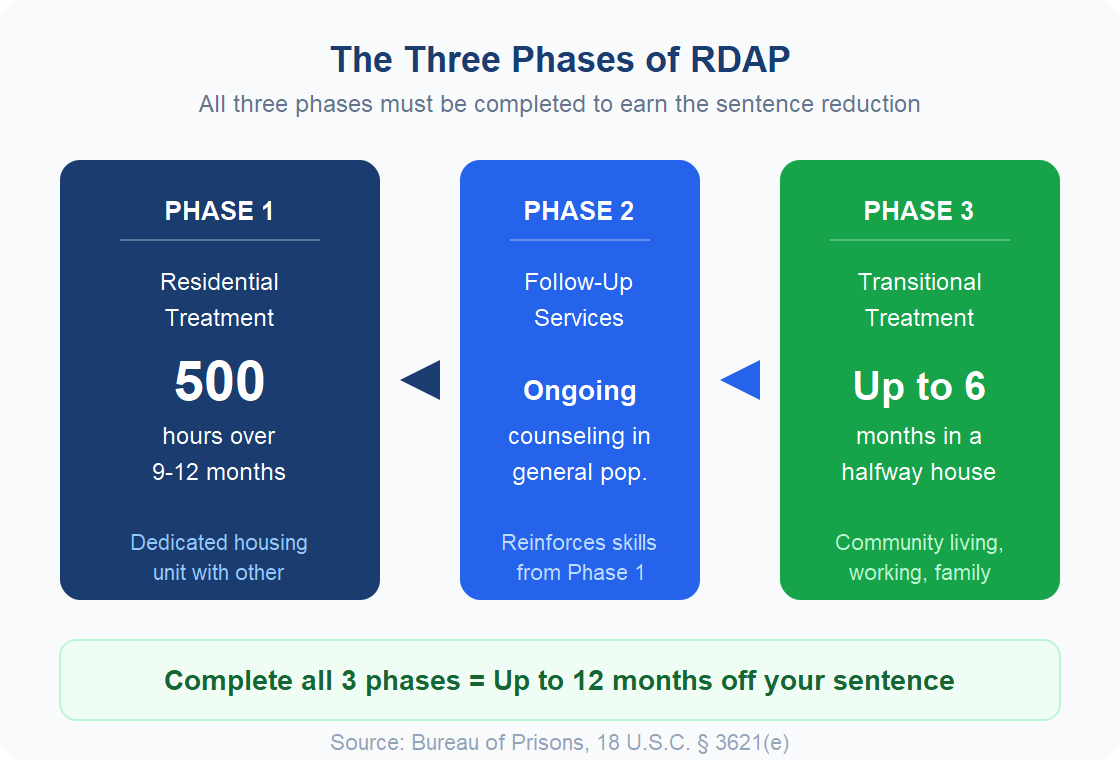
RDAP is not a single event. It is a three-phase treatment continuum that spans your final months of incarceration and your transition back into the community. Each phase must be completed to earn the sentence reduction — finishing only the residential portion is not enough.
Phase 1: Unit-Based Residential Treatment (9-12 Months)
This is the core of the program. You live in a dedicated RDAP housing unit with other program participants for approximately 500 hours of structured treatment over 9 to 12 months. The day is split between program activities — group therapy, individual sessions, cognitive behavioral exercises, and peer accountability — and regular prison work or educational programs. At the end of this phase, you receive a certificate of completion.
Phase 2: Follow-Up Services
After completing the residential component, you return to the general population and participate in ongoing follow-up counseling and support services. This phase reinforces the skills and strategies learned during the residential program. It is the first part of the aftercare requirement.
Phase 3: Transitional Drug Abuse Treatment (Up to 6 Months)
The final phase occurs in a halfway house or on home confinement. This Transitional Drug Abuse Treatment (TDAT) lasts up to six months and bridges the gap between incarceration and full release. You continue treatment while living in the community, working, and rebuilding family relationships. Only after completing all three phases do you receive the official certificate of achievement and the full sentence reduction.
Who Qualifies for RDAP?
Eligibility for RDAP is not automatic. The program has specific criteria that must be met — and mistakes during the intake screening process can disqualify you permanently. Understanding these requirements before you enter the BOP system is critical.
You Must Have a Verifiable Substance Use Disorder
The BOP requires documentation of a substance use disorder within the 12 months prior to your arrest. This documentation must come from a medical professional, substance abuse treatment provider, probation or parole officer, or social worker. Alternatively, two or more DUI/DWI convictions in the five years before arrest can serve as verification. The most important source of this documentation is your Pre-Sentence Report (PSR) — which is why PSR preparation is so critical.
You Must Be Serving a Non-Violent Offense
Only those convicted of non-violent offenses are eligible for the RDAP sentence reduction. Under the BOP’s 2009 rules, the following current offenses disqualify you:
- Felonies involving the actual, attempted, or threatened use of physical force
- Carrying, possession, or use of a firearm, dangerous weapon, or explosives
- Sexual abuse offenses committed against minors
- Attempts or conspiracies to commit any of the above
You Cannot Have Certain Prior Convictions
Even if your current offense is non-violent, prior felony or misdemeanor convictions for the following crimes will disqualify you from the sentence reduction: homicide, forcible rape, robbery, arson, kidnapping, aggravated assault, or child sexual abuse.
Additional Requirements
- At least 24 months remaining on your sentence at the time of enrollment
- Willingness to sign a participation agreement
- Ability to participate in the language the program is conducted in
- Eligibility for halfway house placement (ICE detainees, pretrial inmates, and state/military prisoners are excluded)
RDAP Reduces Recidivism — The Data Is Clear
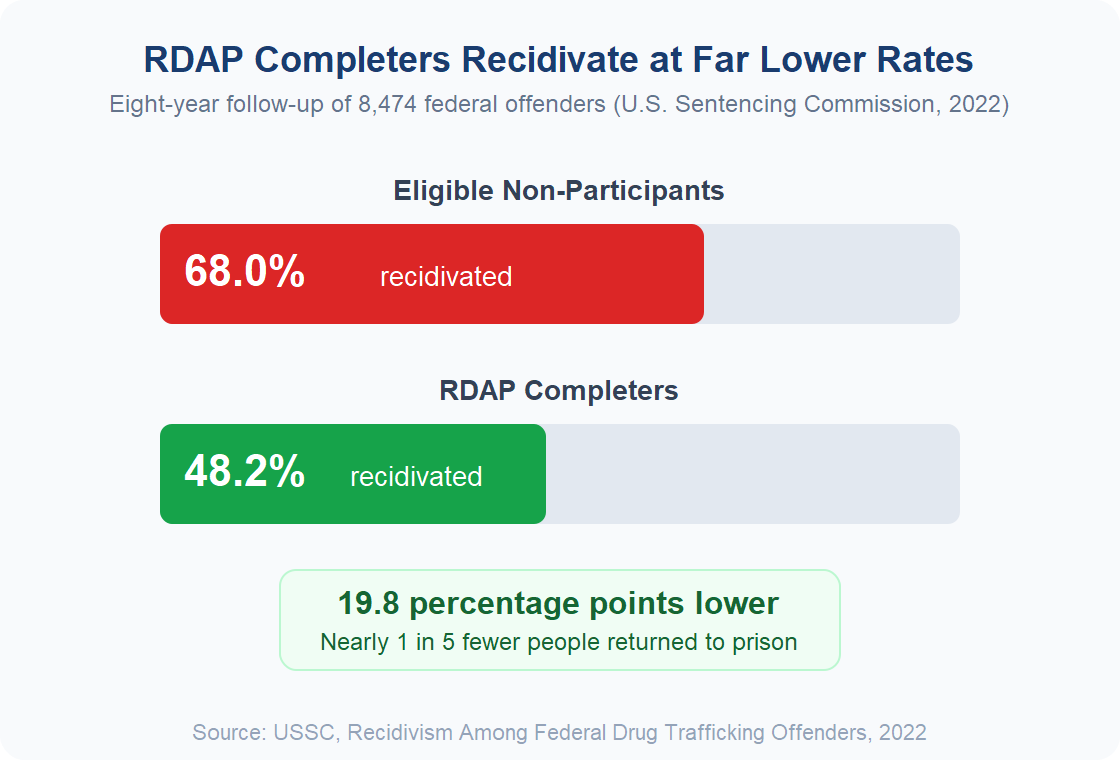
The U.S. Sentencing Commission conducted an eight-year follow-up study of 8,474 federal offenders eligible for RDAP. The results were striking: only 48.2% of those who completed RDAP recidivated, compared to 68.0% of eligible non-participants (USSC, 2022). That represents a nearly 20-percentage-point reduction in recidivism — one of the strongest outcomes of any federal prison program.
An earlier BOP study found that 44.3% of male inmates who completed the program were likely to be re-arrested or have their supervision revoked within three years of release (Federal Register, 2016). Compared to general federal release populations where approximately 45% are rearrested or return to custody within three years (GAO, 2026), RDAP completion is associated with measurably better outcomes across every study that has examined the program.
As Stephanie Forrest, a retired BOP case manager who worked at an RDAP program at FCI Edgefield, told Forbes: “I think the program is successful because it makes productive use of time in prison. I’ve seen a big difference in the way those who participate in the program see their behavior after the program” (Forbes, 2024).
Common Mistakes That Cost People RDAP Eligibility
We have seen dozens of clients who lost their RDAP eligibility — and the up to 12 months of sentence reduction that comes with it — because of avoidable mistakes. The patterns are consistent and preventable.
Minimizing Substance Abuse History During Intake
Many defendants downplay their substance use during the PSR interview or intake screening because they are embarrassed, afraid of stigma, or believe it will hurt their case. This is one of the most costly mistakes in the federal system. Without documented evidence of a substance use disorder in your central file, you cannot qualify for RDAP. Your PSR is the single most important document for establishing this history.
Failing to Send Documentation to the BOP
Even if substance abuse is mentioned in your PSR, supporting documentation strengthens your case. Letters from medical professionals, treatment providers, or probation officers should be sent to the BOP and placed in your central file before intake screening. Most defendants never do this because no one tells them it matters.
Missing the Enrollment Window
You must have at least 24 months remaining on your sentence to enter RDAP. The closer you are to your release date, the higher priority you receive — but if you wait too long, you may not have enough time to complete all three phases and earn the full reduction. Planning your RDAP timeline should begin before sentencing, not after you arrive at your facility.
Behavioral Issues After Enrollment
Getting expelled from RDAP for behavioral violations means losing your sentence reduction and waiting at least 90 days before you can reapply — with no credit for prior participation. Understanding the rules of the therapeutic community before you enter the program is essential. One bad day can cost you a year of freedom.
How Federal Case Consulting Maximizes Your RDAP Outcome
RDAP is not just about qualifying — it is about maximizing every aspect of the opportunity. Our team provides end-to-end RDAP strategy because we have navigated this system ourselves.
PSR Strategy for RDAP Qualification
We work with you before the probation interview to ensure your substance abuse history is properly documented and presented. This includes preparing your personal narrative, identifying supporting documentation, and coaching you through the interview process so that the PSR accurately reflects your eligibility for RDAP.
BOP Designation Advocacy
Not all federal facilities offer RDAP. We advocate for designation to a facility with an active RDAP program, ensuring you are positioned to enroll as soon as you are eligible. Designation to a non-RDAP facility can delay enrollment by months or require a transfer that may not be approved.
Enrollment Timing and Documentation
We track your timeline to ensure you enter RDAP with enough sentence time remaining to earn the maximum reduction. We also coordinate the submission of supporting documentation to your central file so the Drug Abuse Program Coordinator (DAPC) has everything needed for a smooth eligibility determination.
In-Program Support
We prepare you for what the therapeutic community expects — from group participation norms to conflict resolution strategies to the testing procedures you will face. Our clients enter RDAP knowing exactly what to expect, which dramatically reduces the risk of behavioral expulsion.
Transitional Phase Maximization
The final phase of RDAP occurs in a halfway house. We advocate for timely transfer and optimal placement so you spend the maximum allowable time in the community — working, reconnecting with family, and rebuilding your life — rather than waiting behind the fence for paperwork to process.
Do Not Leave 12 Months on the Table
RDAP eligibility starts with preparation — before your PSR interview, before sentencing, before you ever set foot in a federal facility. We have been through this system. Let us help you get it right the first time.
Call or Text: 612-605-3989
Email: info@federalcaseconsulting.com
We respond to every inquiry within 24 hours. Confidential consultations available.
Frequently Asked Questions
How much time can RDAP take off a federal sentence?
RDAP can reduce a federal sentence by up to 12 months for non-violent offenders who complete all three phases. The average actual reduction is approximately 8 months because many inmates enter the program with less than a year of reducible time remaining (Federal Prison Time). Early preparation ensures you enter with enough time to earn the full benefit.
What are the RDAP eligibility requirements?
You must have a verifiable substance use disorder documented within 12 months before your arrest, be serving a non-violent offense, have no disqualifying prior convictions (homicide, rape, robbery, arson, kidnapping, aggravated assault, child sexual abuse), and have at least 24 months remaining on your sentence. The USSC found that 48.2% of completers recidivated versus 68.0% of non-participants over eight years (USSC, 2022).
How long does RDAP take to complete?
The full program spans three phases: 9 to 12 months of residential treatment (500 hours), follow-up services in general population, and up to 6 months of transitional treatment in a halfway house. Only after completing all three phases do you earn the sentence reduction and certificate of achievement. The BOP currently operates 65 RDAP programs at 53 federal facilities (BOP).
Can I get into RDAP if my prison does not have the program?
Yes. Federal inmates at facilities without RDAP can transfer to one of the 53 BOP locations that offer the program. However, the transfer must be approved by the BOP and your security level must be compatible with the receiving facility. A consultant can advocate for designation to an RDAP facility from the start, avoiding the delay of a mid-sentence transfer request.
What happens if I get expelled from RDAP?
Expulsion means losing your sentence reduction entirely. You must wait at least 90 days before reapplying, and you receive no credit for prior participation. Grounds for immediate removal include drug or alcohol use, violence or threats, escape attempts, or violating program confidentiality. Understanding the therapeutic community rules before enrollment significantly reduces expulsion risk.
Disclaimer: Federal Case Consulting does not act as your legal representation and cannot guarantee any outcomes. The information in this article is for educational purposes and should not be construed as legal advice.