
The date is already on your judgment order. Sometime in the next 30 to 90 days, you will drive yourself to a federal facility, hand over your phone and wallet, and not sleep in your own bed again for a long time. What you do with the weeks in between decides how hard that first year hits.
The window between sentencing and self-surrender is short, usually 30 to 90 days. That is the entire runway you have to shut down your outside life and prepare for years, sometimes decades, of federal custody.
Most defendants spend that time in shock. The ones who use it well arrive at the gate with their affairs in order, their family stabilized, their finances handled, and a clear plan for what programs, work, and education they will pursue on the inside. The difference shows up in every month of the sentence that follows.
- The Bureau of Prisons Designation and Sentence Computation Center (DSCC) in Grand Prairie, Texas, decides where you serve time based on 18 U.S.C. § 3621(b) factors: offense, security level, medical needs, family ties, and judicial recommendation.
- Self-surrender is almost always better than remand. It keeps you out of local jail during designation and lets you drive yourself to the assigned facility.
- You have a limited pre-surrender window (typically 30 to 90 days from sentencing) to handle every financial, medical, legal, and family task.
- Programs like RDAP and First Step Act earned time credits can reduce your time served by up to 12 months each when you qualify (18 U.S.C. § 3621(e)(2)(B); First Step Act of 2018).
What Does Preparing for Federal Prison Placement Actually Involve?
Preparing for federal prison runs on two parallel tracks: logistical and mental. Both start the day sentence is imposed and both continue right up to the moment you walk through the gate.
The logistical track is a series of tasks with deadlines. Financial accounts, tax filings, powers of attorney, medical records, employment resignation, vehicle storage, mail forwarding, and the paperwork BOP uses to place you.
The mental track is quieter but heavier. It’s the shift from denial to acceptance to planning. From “this cannot happen” to “this is happening, and here is how I will use the time.”
Both tracks are covered in this guide, along with the specific documents, systems, and BOP rules that determine how well the surrender goes.
How Does BOP Decide Where You Serve Your Sentence?
The Bureau of Prisons Designation and Sentence Computation Center (DSCC) in Grand Prairie, Texas, makes the designation decision. Under 18 U.S.C. § 3621(b), DSCC must consider five statutory factors:
- The resources of the facility contemplated
- The nature and circumstances of the offense
- The history and characteristics of the prisoner
- Any statement by the court that imposed the sentence
- Any pertinent policy statement issued by the Sentencing Commission
DSCC then applies BOP’s internal classification math from Program Statement 5100.08. Points are assigned for offense severity, criminal history, education, drug use history, and prior disciplinary record.
The point total maps to a security level: minimum (camp), low, medium, high (USP), or administrative. Facility assignment is then chosen from that security band with attention to bed availability and (statutorily) proximity to the inmate’s release residence.
18 U.S.C. § 3621(b) was amended by the First Step Act of 2018 to require BOP to place inmates within 500 driving miles of the release residence “to the extent practicable.” Security level, medical needs, and bed availability still win when they conflict, but the 500-mile preference is now a written statutory factor.
Judicial Recommendations Matter
The judgment order can carry a judicial recommendation on facility, program (like RDAP), or region. BOP is not bound by it, but DSCC gives judicial recommendations real weight, especially on RDAP designation and proximity requests.
Ask your attorney to include the recommendation in the judgment before the sentencing hearing ends. Once the judgment is entered, it becomes much harder to add.
Self-Surrender vs. Remand: Which Should You Aim For?

Self-surrender is when the court sets a “report date” on the judgment and lets the defendant drive to the designated facility on their own. Remand is when the judge takes the defendant into custody immediately at sentencing, and the U.S. Marshals move them through county jails to the eventual BOP facility.
Self-surrender is dramatically better for nearly every reason: it keeps you out of local jail during the designation wait, lets you handle final logistics from home, and preserves visitation with family before you leave.
Non-violent offenders, first-time defendants, defendants who were on pretrial release without violation, and defendants whose plea agreement recommends self-surrender. Judges have discretion. The defense should specifically request self-surrender at sentencing and support it with pretrial-compliance evidence.
How to Strengthen a Self-Surrender Request
- Documented pretrial compliance (zero missed check-ins, zero violations)
- Steady employment during the pretrial period
- Family and community ties supporting flight-risk analysis
- Written statement from the defense on the practical need for self-surrender (elderly parents, minor children, business wind-down)
- Government non-opposition (much easier if the plea agreement contemplated it)
What Are the Logistical Steps in the Weeks Before Surrender?
Whatever your report date (usually 30 to 90 days out), the work breaks into three phases: legal and financial first, family and medical in the middle, and last-week wind-down at the end. The 60-day model below is a common baseline. Compress it if your date is sooner, stretch it if the court gives you more time.
None of this happens on autopilot. Every task on the checklist below is something a family member, attorney, or federal prison consultant has to actively execute in the pre-surrender window.
| Phase | Timing | Focus |
|---|---|---|
| Phase 1: Legal + financial | Days 1 to 14 after sentencing | Powers of attorney, business succession, tax filings, debt communication |
| Phase 2: Family + medical | Days 15 to 35 | Custody arrangements, medical records, prescriptions, school communications |
| Phase 3: Property + surrender | Days 35 to report date | Vehicle storage, mail forwarding, home security, travel to facility |
Start Phase 1 on the day of sentencing. Anything you defer here shows up as a crisis somebody has to handle from the outside once you’re inside.
What Documents and Systems Should You Set Up?
Every inmate arrives at the gate with the same problem: they can no longer sign, deposit, testify, decide, or intervene in their own life. Somebody outside has to be able to do all of that on their behalf.
That means legally granted authority, current documents in a designated file, and communication systems that work across a locked wall.
Documents to Prepare Before Surrender
- Durable financial power of attorney for a trusted person (spouse, adult child, sibling, attorney)
- Healthcare power of attorney / advance directive covering incapacity
- Guardianship or custody paperwork for any minor children
- Updated will and beneficiary designations (life insurance, retirement accounts, POD accounts)
- Business succession plan or operating agreement amendments if you own a business
- Vehicle title and registration transfer or long-term storage documentation
- Complete tax filings for all open years, plus 4868 extensions for any that fall due during custody
- Original documents in a family binder: birth certificates, passports, marriage certificate, DD-214, mortgage/lease paperwork
- Medical records summarizing chronic conditions, current medications, allergies, and specialist contact information
- List of user IDs and password locations for banks, utilities, and household services (stored with the person holding your POA)
Financial Systems That Keep Working from Inside
Bills continue whether you are home or not. Utilities disconnected mid-sentence are hard to restore. Mortgages missed become foreclosures.
Set up autopay for every recurring bill. Consolidate accounts into one bank if possible. Give your power of attorney holder access to see and pay from every account.
Communication Systems That Reach Inside
BOP inmates use TRULINCS (email) and phone minutes. Add family, attorney, and any professional contacts to your approved contact list on your first day inside. Off-list contacts cannot email or accept your calls.
For visits, family members must submit a visitor application questionnaire (obtained from the facility’s visiting office) and pass a background check before they can visit. Start that process before surrender if possible.
What Should You Bring on Surrender Day?
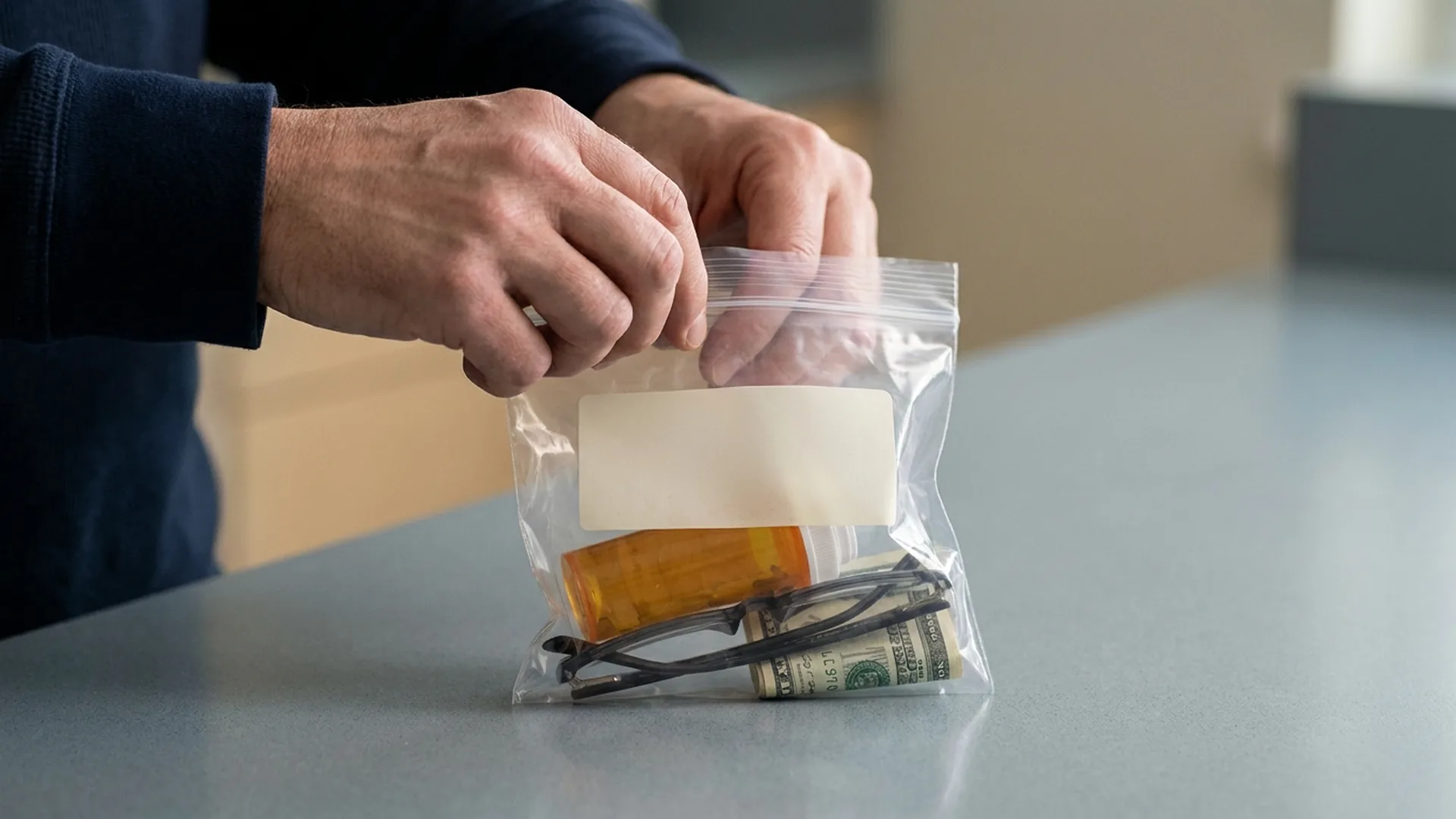
Very little. BOP intake will confiscate almost everything you show up with. The rule is: arrive with nothing that you would miss.
What to Bring to Surrender
- Government-issued photo ID (driver’s license or passport)
- Social Security card (or a copy)
- The judgment and commitment order (or a copy) if you have it
- Facility address and directions and, if driving, someone to take the vehicle home afterward
- A single set of over-the-counter medications on the BOP allowed list in original packaging (call the facility’s health services department to confirm what they will accept)
- Prescription medication in original bottles with the pharmacy label intact
- Eyeglasses or contact lenses in a case (no colored contacts)
- Small amount of cash for the initial commissary deposit (limits vary by facility; often $50 to $300 in cash or money order)
Jewelry (including wedding rings, a common mistake), cell phones, weapons of any kind, prescription medication not in the original labeled bottle, cash above the facility limit, personal papers with contact info for other people, tobacco products, or anything electronic. Everything on this list will be confiscated or refused, and some of it can trigger disciplinary write-ups on day one.
What to Wear
Simple street clothes you don’t mind losing. Comfortable shoes without steel toes. No belts with metal buckles above a certain size. BOP intake will issue institution clothing on arrival, and your street clothes get shipped home or discarded.
How Do You Prepare Mentally for Federal Prison?

Mental preparation is not a pep talk. It is a set of practices you build in the weeks before surrender so that when the door closes behind you, you already have a working plan for how you’ll spend your time inside.
The three biggest mental hurdles are loss of autonomy, family separation, and the collapse of time into daily routine. Every prepared defendant has thought about each one in advance.
Accept the Loss of Autonomy Early
Inside, you don’t choose when you eat, when you sleep, who you talk to, or where you stand in line. The defendants who arrive still fighting this lose more than the defendants who accept it in the parking lot.
The trick is to shift the definition of control. You cannot control the schedule; you can control what you do inside the schedule. Programs, exercise, reading, correspondence, education.
Build a Communication Rhythm with Family
Decide before surrender: what days will you call, what days will they visit, how often will you write, and who is in charge of relaying updates to whom.
A predictable rhythm reduces the anxiety on both sides. A silent week feels like a month when nobody knows why.
Set Concrete Goals for the Sentence
Every sentence is time. What do you want to leave with that you didn’t come in with? Common goals:
- Complete RDAP if eligible (up to 12 months off)
- Complete BOP-approved education programs (GED, college courses through partner universities)
- Complete a trade certification through UNICOR or facility vocational programs
- Read a target number of books (BOP libraries + family-mailed books)
- Rebuild physical fitness
- Repair specific family or personal relationships damaged by the case
Writing these down before you go inside gives you something to point at when the days blur together.
The single most consistent piece of advice from people who have completed federal sentences is this: bring a plan for the first 30 days, not for the whole sentence. Learn the facility, find the programs, meet a couple of people who are doing their time the way you want to do yours, and expand from there.
How Do BOP Programs Fit into Your Sentence Plan?
The two programs with the biggest sentence-length impact are the Residential Drug Abuse Program (RDAP) and First Step Act earned time credits (FSA ETCs). Both can reduce time actually served, and both require documentation that starts before you surrender.
RDAP: Up to 12 Months off the Sentence
Under 18 U.S.C. § 3621(e)(2)(B), the BOP may reduce a nonviolent offender’s sentence by up to 12 months for successful completion of RDAP. Qualifying requires a documented substance abuse disorder within 12 months of arrest, no disqualifying offense, and BOP acceptance into the program.
The documentation for RDAP eligibility is captured in the presentence report. If your PSR doesn’t reflect a real substance-abuse history, you may lose access to the reduction, so raise it with counsel before the PSR is finalized.
First Step Act Earned Time Credits
The First Step Act of 2018 created earned time credits for eligible inmates who complete evidence-based recidivism reduction programs. Credits can be applied toward earlier release to a halfway house or home confinement.
For a deeper look at how FSA credits stack with good time credits and RDAP, see our guide to First Step Act earned time credits.
Education, Work, and Vocational
Every facility offers a differing mix of GED prep, college partnerships (Ashland University, Second Chance Pell), UNICOR industrial work, vocational trades (welding, HVAC, food service), and evidence-based classes recognized under FSA.
Ask the facility handbook for the current program list on your first week inside, and pick two or three to start immediately.
How Does a Federal Prison Consultant Prepare You for Placement?
A federal prison consultant runs the preparation workflow that most attorneys do not have time to run. Your criminal defense lawyer finishes the legal work at sentencing; the consultant takes over the surrender, designation, and program-strategy work in parallel.
What the Consultant Actually Does
- Analyzes the presentence report for RDAP eligibility, medical designation, and security-level implications
- Drafts the judicial recommendation language for the judgment order (facility, program, region)
- Coordinates with the U.S. Probation Office on self-surrender arguments
- Prepares the pre-surrender document binder (POA, wills, medical, financial)
- Advises on facility choice and BOP designation strategy
- Runs mental preparation sessions covering intake, first-30-day survival, and family communication
- Coordinates with family on visiting, phone, TRULINCS, and commissary setup
The consultant is not a lawyer and does not replace counsel. The two roles work side by side, and the surrender lands better than it would with either one working alone.
Preparing for Federal Prison Placement?
Federal Case Consulting works in all 94 federal judicial districts. We prepare defendants and families for surrender, coordinate BOP designation, and build the program strategy that shapes the entire sentence.
How Do You Support a Family Member Preparing to Surrender?
The family side of surrender is often harder than the defendant side. Family members lose the primary parent, spouse, or breadwinner and inherit responsibilities they were never trained for.
Preparation for family runs on the same timeline as the defendant, and dedicated family support services exist for exactly this transition. Every task on the defendant’s checklist has a family counterpart.
Family Checklist Before Surrender
- Complete visitor application forms (obtained from the specific facility’s visiting office) for anyone who will visit
- Set up TRULINCS (email) accounts once the inmate is designated
- Establish the family communication rhythm (call days, visit days, mail cadence)
- Set up the commissary funding method (WesternUnion QuickCollect, MoneyGram ExpressPayment, or JPay depending on facility)
- Save the facility’s mailing address, phone number, and health services contact
- Identify one family point-of-contact for emergencies
- Set up a shared calendar for court, program, and release milestones
- Coordinate with schools, employers, and community for family support during absence
Frequently Asked Questions
How Long After Sentencing Do I Have Before I Surrender?
The judgment order sets a specific report date. In most self-surrender cases, that date is 30 to 90 days after sentencing, though the exact date is set by the court in its discretion based on how long DSCC needs to designate you and how much personal wind-down time the judge allows.
The court can extend the report date on motion with good cause (medical, family emergency, business dissolution). Motions to extend are usually granted once when the reason is documented.
Can I Request a Specific Federal Prison?
You can request. BOP is not bound by the request. The judge can include a judicial recommendation in the judgment order, and BOP gives that recommendation weight but makes the final designation based on 18 U.S.C. § 3621(b) factors.
The 500-mile-from-release-residence preference under the First Step Act helps in many cases, but security level and bed availability still win when they conflict.
What Happens on the Day I Surrender?
You arrive at the designated facility on or before the report date and time. Intake takes several hours: identification, medical screening, initial security review, property inventory, and issuance of institution clothing.
You will be assigned a housing unit and a bunk. First-day rules cover phone, email, commissary, and program access. The details vary by facility, but the sequence is nearly identical everywhere.
How Much Money Can I Bring for Commissary?
Facilities set their own initial deposit limits, and the amount varies. Many camps and lows accept an initial deposit of $50 to $300 in cash or money order at intake. Ongoing commissary funding after that comes from outside deposits via WesternUnion QuickCollect, MoneyGram, or JPay.
Confirm the current amount with the specific facility before surrender day.
Can Family Visit Before Designation Is Final?
No. Visits require an approved visitor application questionnaire processed by the specific facility. Once the inmate is designated and the facility receives the application, the process typically takes several weeks.
Submit family visitor applications as soon as the designation is confirmed. Do not wait until the inmate arrives.
What Is the Worst Mistake Defendants Make in the Pre-Surrender Window?
Deferring the paperwork. Every task deferred to “after I get inside” becomes a crisis a family member has to handle without the defendant’s signature, login, or memory.
Powers of attorney signed the week of surrender are often incomplete. Tax filings put off until the last week become missed deadlines. Medical records not gathered before intake are not available during intake, when BOP health services actually needs them.
Should I Hire a Federal Prison Consultant for Placement Preparation?
If you or a loved one is facing self-surrender within 90 days, a federal prison consultant substantially raises the odds that designation, programs, and family systems all line up correctly.
A consultant does not stand in for your criminal defense attorney. Each covers a different part of the process, and together they leave you far better prepared for surrender than the lawyer has time to manage alone.
Final Thoughts
Federal prison placement is a process, not an event. The month before surrender is when preparation actually happens, and the month after arrival is when the plan gets tested.
Handle the logistics before you go inside. Set up the systems that let outside life keep running. Line up the programs that will shape your sentence math. Communicate with family in a predictable rhythm.
None of this makes the sentence shorter by itself. What it does is give you a stable platform to work from. Every reduction that follows, RDAP, First Step Act credits, halfway house, home confinement, starts from that platform.
Talk to a Federal Prison Consultant
Federal Case Consulting has walked defendants and families through federal prison placement in all 94 federal judicial districts. We build the pre-surrender plan, coordinate BOP designation, and prepare families for the transition.
Sources
- Cornell Law School Legal Information Institute, 18 U.S.C. § 3621 (Imprisonment of a Convicted Person; BOP designation authority and RDAP), retrieved 2026-07-10.
- Federal Bureau of Prisons, Program Statement 5100.08: Inmate Security Designation and Custody Classification, retrieved 2026-07-10.
- Federal Bureau of Prisons, Designation and Sentence Computation Center (DSCC), retrieved 2026-07-10.
- U.S. Congress, First Step Act of 2018, Pub. L. No. 115-391 (500-mile placement preference and earned time credits), retrieved 2026-07-10.
- Cornell Law School Legal Information Institute, 18 U.S.C. § 3143 (Release or Detention of a Defendant Pending Sentence or Appeal; self-surrender authority), retrieved 2026-07-10.
- Federal Bureau of Prisons, Program Statement 5267.09: Visiting Regulations, retrieved 2026-07-10.
- Federal Bureau of Prisons, Program Statement 5330.11: Psychology Treatment Programs (RDAP), retrieved 2026-07-10.
- U.S. Sentencing Commission, 2024 Annual Report and Sourcebook of Federal Sentencing Statistics, retrieved 2026-07-10.