
The presentence investigation report is the most powerful document in any federal case. It controls your sentence, your prison placement, and your First Step Act eligibility. Here is what to prepare, what to say, and what to object to before the draft is filed.
Get a free, private call with people who have lived through the federal system. We help you walk in prepared.
- Federal law (18 U.S.C. § 3552(a)) requires a presentence investigation (PSI) in almost every case. Of 61,678 federal defendants sentenced in FY2024, 97.2% pleaded guilty (USSC, 2024). That means nearly every federal case runs through this process.
- Federal Rule of Criminal Procedure 32 sets the clock. The draft PSR has to be shared at least 35 days before sentencing. You then have 14 days to file written objections.
- The PSR follows you long after the courtroom. The Bureau of Prisons uses it to set your security level under Program Statement 5100.08. It also drives your First Step Act time-credit eligibility under 18 U.S.C. § 3632(d)(4)(D).
If you just pleaded guilty in federal court, the next person you meet is rarely your judge. It’s a U.S. Probation Officer. The report they write will shape your case more than almost anything you have seen so far.
The presentence investigation report (PSR) is the most powerful document in federal sentencing. The judge reads it line by line. The Bureau of Prisons uses it to decide where you serve. The First Step Act treats it as the official record of your offense.
Most federal defendants meet their probation officer one time. They answer a few hours of questions. They walk out without knowing how much of their future they just handed over.
This guide walks through what the PSI is, what the rules say, what to bring to the interview, and how to object to errors. A careful PSI is the difference between a manageable sentence and one you fight for years to undo.
What Is a Presentence Investigation in Federal Court?
A presentence investigation is a court-ordered fact-finding into your case. A U.S. Probation Officer runs it between your conviction and your sentencing. They look at your offense, your background, and your life.
Federal law (18 U.S.C. § 3552(a)) makes the investigation required in nearly every federal case:
“A United States probation officer shall make a presentence investigation of a defendant… and shall, before the imposition of sentence, report the results of the investigation to the court.”
The investigation produces the presentence report, often called the PSR or PSI report. Federal Rule of Criminal Procedure 32(d) tells the probation officer exactly what to put in it:
- The offense conduct
- The Guidelines math (offense level, criminal history category, and final range)
- The sentencing factors under 18 U.S.C. § 3553(a) (the federal law that lists what a judge weighs)
- Your personal and family history
- Your money picture
- Your physical and mental health
- Any victim-impact information
- The sentencing options on the table
The PSR is not a neutral summary. It is an argument in disguise.
The probation officer talks to you. They talk to the prosecutor. They review the case file and pull your records. Then they write a story the judge will treat as the default version of who you are.
Every word matters. Step one is to accept that.
Who Writes the PSI and How Long Does It Take?
A U.S. Probation Officer in the district where you were convicted writes your PSR.
Rule 32 locks in the schedule. Sentencing is usually set 70 to 90 days after conviction. The draft PSR has to reach you and your attorney at least 35 days before sentencing (Fed. R. Crim. P. 32(e)(2)). The final PSR, with any addendum, is filed at least 7 days before sentencing under Rule 32(g).
The officer usually calls within 7 to 14 days of your guilty plea to set up the PSI interview. Most interviews run 90 minutes to 3 hours. Your attorney has the right to be there and should be.
After the interview, the officer needs 30 to 45 days to pull records (criminal, work, school, military, medical, immigration), write the report, and send out the draft.
The Administrative Office of U.S. Courts Guide to Judiciary Policy, Volume 8, Part D sets the same rules for federal probation officers across the country.
They are not your enemy. They are also not on your side. Their loyalty is to the court. Treat every meeting that way.
What Happens During the Presentence Interview?
The interview is where the officer pulls the personal-history facts that fill about half the PSR.
Expect questions in five areas: the offense, your criminal history, your family and personal history, your job and school history, and your health and drug use. The officer also checks your money picture for any future restitution, fine, or forfeiture.
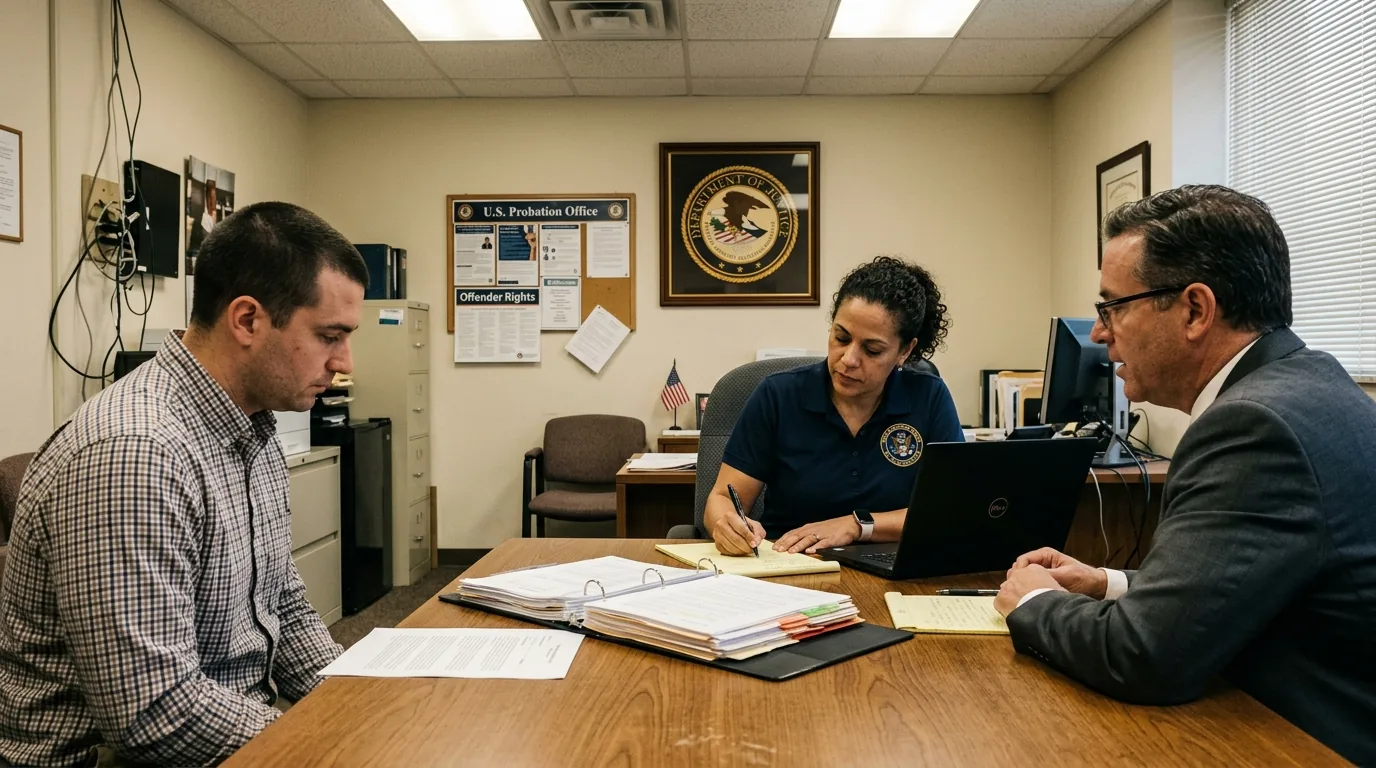
Bring documents. The officer rarely has time to chase down backup records. Anything you hand them at the interview tends to land in the PSR word for word. Useful documents include:
- Birth certificate
- Education transcripts and diplomas
- Military DD-214
- Employment letters and verification
- Tax returns or recent pay stubs
- Medical records and mental-health diagnoses
- Addiction treatment history
- Immigration paperwork
- Character letters and community-service records
Hand the officer one clean, organized binder. Your personal-history section then reads like a full picture instead of a few self-reported sentences.

What You Should Not Say
Do not re-argue the offense. Do not play it down. Do not blame co-defendants. Do not back away from facts you already admitted in the plea deal. Do not bring up other conduct that is not already on the record.
Acceptance of responsibility under U.S.S.G. § 3E1.1 (the Guideline that rewards owning your conduct) can give you a 2 to 3 level cut. Application Note 3 says a guilty plea is “significant evidence” but not a sure thing.
The PSI interview is where defendants most often lose that cut by saying the wrong thing.
Bring Your Attorney
Your attorney at the interview is your best shield. They keep unclear answers from turning into bad PSR language.
A good federal defense attorney sets ground rules with the officer in advance. They sit in. They step in when needed. They send extra letters after to fill any gaps.
If your attorney plans to skip the interview, that is a red flag. Reschedule.
What’s Inside the Presentence Investigation Report?
The federal PSR has standard sections set by Rule 32(d).
Every PSR has the offense math (base offense level, add-ons for the type of crime, role in the offense, acceptance of responsibility, total offense level). It has the criminal history math (points, category, any cuts). It has the final Guidelines range.
Those numbers are the heart of the report. They are the most common source of fact fights.
Beyond the math, the PSR has:
- The offense conduct story
- Victim impact
- Your personal and family history (childhood, marital status, dependents, drug use, mental health, school, work)
- Your ability to pay
- A fact section for each sentencing factor under 18 U.S.C. § 3553(a)
- The probation officer’s suggested sentence (in some districts)
- A list of any reasons the judge could go above or below the Guideline range
The section most defendants miss is the offense conduct story. The officer will lean on the prosecutor’s version unless you put yours in writing first.
Arguments at the sentencing hearing are hard. Objections at the PSR stage are routine. Fix the offense story now, or live with that paragraph in your BOP file for the whole sentence.
Will You Be Drug Tested at Your Presentence Investigation?
Yes, in most federal districts. Federal probation officers often drug test at the PSI interview. They do it when you have any history of drug use, when drugs are part of the offense, or when you are on pretrial release with drug-testing rules.
The AO Courts Guide to Judiciary Policy, Volume 8, Part D, gives officers wide power to check drug use during the investigation.
A positive test can hurt you in four ways. It can cost you the acceptance-of-responsibility cut. It can get your pretrial release pulled. It can add “status points” to your Criminal History Category. It can also feed the BOP’s drug-history scoring when they pick your prison.
If you have a known drug problem, line up a current treatment plan before the interview. Showing up to treatment on your own almost always reads better than a positive test you have to explain.
How to Object to PSI Errors Under Rule 32(f)
Rule 32(f)(1) gives you 14 days from the day you get the draft to file written objections:
“Within 14 days after receiving the presentence report, the parties must state in writing any objections, including objections to material information, sentencing guideline ranges, and policy statements contained in or omitted from the report.”
Miss the 14-day window and you usually lose the objection. In practice, this deadline does not move.
The most common and most costly PSR objections fall into four buckets:
- Wrong base offense level (the wrong Guideline was used)
- Wrong add-ons for the crime type (drug amount, loss amount, role)
- Wrong enhancements (gun, vulnerable victim, abuse of trust)
- Wrong criminal history points
A single point change in criminal history can bump you from Category I to Category II. That can add months to the Guideline range.
Once you file objections, Rule 32(f)(3) lets the officer look into them and meet with both sides to try to work them out.
Anything not worked out goes into an addendum under Rule 32(g), filed at least 7 days before sentencing. The court has to deal with it at the hearing.
Written objections build a record you can use on appeal. Verbal gripes at sentencing usually do not.
How Your PSI Affects Sentencing, BOP Placement, and First Step Act Eligibility
The PSR feeds three separate decisions, not one.
The first is your sentence. Judges gave non-government downward variances (sentences below the Guideline range) in 28.7% of FY2024 cases (17,680 of 61,678 sentenced, per USSC Sourcebook Table 40, 2024). Those wins follow PSR-stage work that gives the judge a reason.
A clean acceptance cut under § 3E1.1 plus a § 5K1.1 motion (the Guideline that rewards “substantial assistance” to the government, granted in roughly 9.9% of FY2023 cases or 6,354 cases per USSC Sourcebook Table 37, 2023) can drop a Guideline range by years.
BOP Custody Classification
The Bureau of Prisons uses your PSR to score your security level under Program Statement 5100.08.
The BOP’s Designation and Sentence Computation Center pulls the severity of your current offense, your criminal history, any violence, any escape history, and your education straight from the PSR.
Errors in the offense or criminal history sections can push you up a security level. That can be the difference between a camp near family and a low-security prison hundreds of miles away.

First Step Act Earned-Time Credits
Under 18 U.S.C. § 3632(d)(4)(D), people serving time for crimes on the Act’s banned list cannot earn FSA Time Credits.
The BOP uses the offense-of-conviction and offense-conduct sections of your PSR to make that call, per its FSA Disqualifying Offenses rules.
A sloppy offense-conduct paragraph can cost you up to 365 days of earned credits and early-release time. That is almost a full year of freedom that the PSI decides.
For a deeper look at the related programming track, see our guide on how RDAP can reduce your federal sentence by up to 12 months. RDAP eligibility is decided from the same PSR sections.
The 2024 Status-Point Amendment
USSC Amendment 821 Part A cut “status points” under § 4A1.1(d) from 2 to 1. It cut them to 0 for defendants with 6 or fewer criminal history points. Both Part A and Part B took effect November 1, 2023, with retroactive sentence-reduction motions allowed starting February 1, 2024.
That means the PSR’s criminal-history math now matters more than ever. A correct PSR can make you eligible for time off going back. A wrong one can block it.
Frequently Asked Questions
How long does the federal presentence investigation take?
The PSI process usually runs 60 to 90 days from your guilty plea to the final PSR. Rule 32 says the draft has to go out at least 35 days before sentencing. The final report (with addendum) goes out at least 7 days before. With 61,678 federal sentencings in FY2024 (USSC, 2024), most districts hold these dates tight.
Can I refuse to talk to the probation officer?
You can skip some topics, especially anything that could add to your offense conduct. But refusing the whole interview almost always costs you the acceptance-of-responsibility cut under U.S.S.G. § 3E1.1. Most federal defense attorneys say to show up with your lawyer, answer personal-history questions, and keep offense talk to what is already in the plea deal.
Who reads my federal PSR?
Your sentencing judge, both sides’ attorneys, the probation officer, and (after sentencing) the Bureau of Prisons all read it. Under Rule 32(c), the PSR is sealed. It is still shared with the BOP for prison placement and program calls. Federal courts treat PSRs as private. Most public records requests are denied without a court order.
What if my PSI report has errors?
You have 14 days from the draft to file written objections under Fed. R. Crim. P. 32(f)(1). The officer has to deal with each one in an addendum before sentencing. The court has to rule on every open fact dispute that affects the sentence, under Rule 32(i)(3). Fixes at this stage can change the Guideline range, your BOP security level, and your First Step Act eligibility.
Does the PSI affect my prison placement?
Yes. The Bureau of Prisons uses the PSR to score your security level under Program Statement 5100.08. Severity of your current offense, criminal history, any violence, and education are pulled straight from the report. Errors can push you to a higher security level and a prison farther from your family.
Conclusion: The PSI Is the Whole Game
By the time most federal defendants grasp the weight of the presentence investigation, the interview is over and the draft is already written. Don’t let that be your story.
Treat the PSI as the moment your sentence is really written, not the courtroom hearing 60 days later. Pull the documents. Sit with your attorney. Object to every error in writing within 14 days.
Get the offense conduct paragraph right. It follows you into the BOP, into the First Step Act math, and into every parole and clemency call for years.
Work With a Federal Prison Consultant
A federal prison consultant runs the hands-on work between plea and reporting day: PSR prep, sentencing mitigation, BOP placement, RDAP and First Step Act planning. The first call is free and private.